The six gates of Lucca and the
The story that each one hides.
For centuries, passing through one of these gates was the only way to enter Lucca. Today, no one asks for documents, but each one still holds a story worth stopping to listen to.
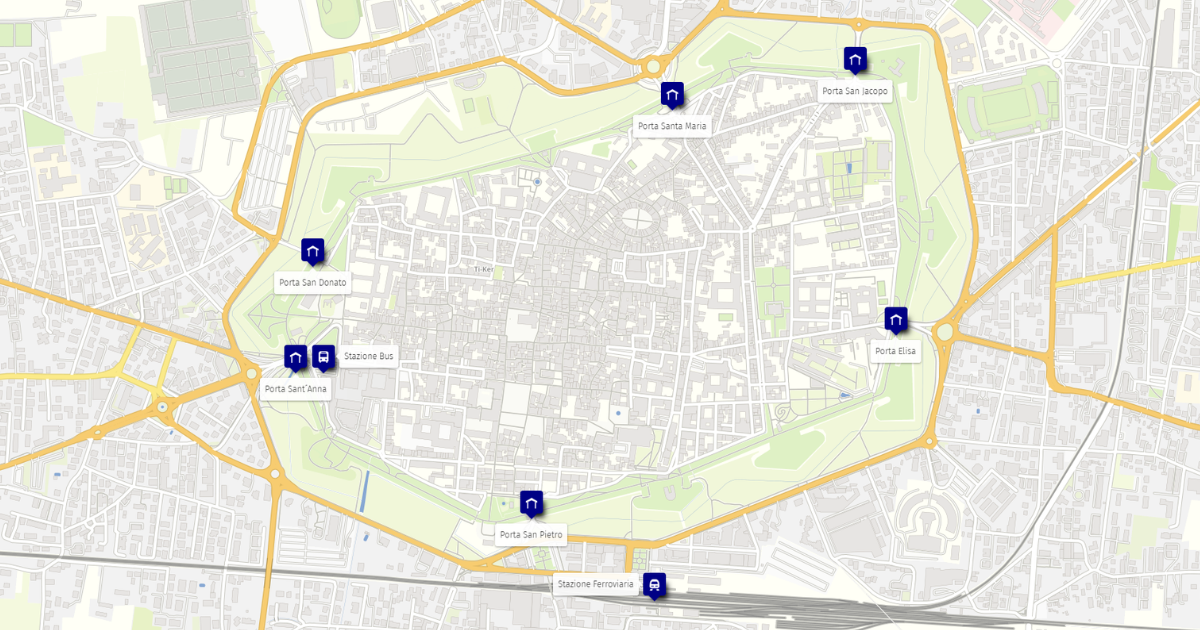
To understand Lucca, it's necessary to know that the city is embraced by two circuits of memories: the six Renaissance city walls gates (which involve the center) and the remaining medieval doors, which are now located in the city center and show where Lucca ended centuries ago.
The 6 Gates of the Renaissance Wall
St. Peter's Gate (The historic and oldest entrance on the current circuit)
Built at the end of the 16th century, it was for centuries the main access point for outsiders. Today, it is the gateway to contemporary Lucca for those arriving from the train station. Look up before crossing: engraved at the top is the word LIBERTAS, the motto of the ancient Republic of Lucca — a reminder that this was, for centuries, a city that made independence its greatest achievement.
Holy Mary Door (The North Gate)
One of the three original gates of the Renaissance design, along with San Pietro and San Donato. Facing north, it is one of the most elegant and is now heavily used daily by those who live in the city. Passing through it is an excellent way to see the local dynamism of Lucca.
San Donato Gate (The double door and the darkest episode)
In fact, the story here is divided into two parts: Old San Donato Gate (from 1590, located inside the square) and the New, built when the final section of the wall was completed. Traces of the defensive engineering can still be seen alongside the old structure.
It is also the site of one of the most significant episodes in the city's history: on July 29, 1845, the last execution by guillotine in Italian history took place there. While the Grand Duchy of Tuscany had abolished the death penalty almost 60 years earlier, the independent Duchy of Lucca still maintained it. Two years later, in revolt, the population seized and destroyed the guillotine in the local prison.
Porta Elisa (The only one with a woman's name)
Named in honor of Elisa Bonaparte Baciocchi, Napoleon's sister and Princess of Lucca in the early 19th century. She was the one who ordered the opening of this neoclassical access road, facing Florence — historically Lucca's great rival — a delicate urban planning and political decision for the time.
Porta Sant'Anna (The gateway to modernity)
Opened in the early 20th century (1911) to accommodate the city's growth, it connects the historic center to the residential neighborhoods to the west (such as San Donato). Known locally as Covered DitchIt doesn't seek the monumentality of the ancient walls, but it serves as a reminder of how the wall adapted to everyday life.
Porta San Jacopo (The youngest of the six)
Opened in 1930, it is the most recent gate in the Renaissance circuit. Located to the northeast, it was created to facilitate the flow of traffic and pedestrians between the city center and the outer neighborhoods. At its top, it is possible to see the coat of arms of Lucca carved in stone, marking the last opening intervention in the fortification.
The Medieval Inner Doors (The old circuit)
Before the construction of the current wall (16th-17th centuries), Lucca was protected by a medieval wall from the 13th century. Two of its gates survived and are still standing today. within the historic center, marking the old city limits:
- Gate of the Villages: Located at the end of Via Fillungo, to the north, with its two lateral stone towers and the image of Our Lady in the arch, it is one of Lucca's most impressive medieval structures. Most visitors pass by it without realizing that, 700 years ago, it was the city's final boundary.
- San Gervasio Gate (or Porta della Annunziata): Located to the east, near Via del Fosso, it retains its imposing sandstone towers and marks the ancient departure point towards Florence in medieval times.
Tip from someone who lives here: The next time you pass through one of these gates, whether it's the monumental San Pietro or the medieval Porta dei Borghi, pause for a few seconds under the arch before moving on. Each one is, in its own way, a small time capsule of Lucca's urban planning.
Want to explore the city without missing a single detail? Check out my e-book. LUCCA: far beyond the walls, I've compiled complete itineraries, transportation tips, and secrets that only locals know.